

Products
FRMS
Managing crew fatigue risk
Every crew duty runs through a biomathematical engine. The planner sees the score, the grounds behind it, and can test alternatives before the roster is published. The decision that follows runs a full cycle through to a check on whether the measure worked.
The airline's problem
Duty-time limits set the formal boundaries. They do not separate two duties of equal length that place sleep, wakefulness and work differently against the circadian rhythm.
One duty may end in daylight; another lands at the end of the night after a short rest. By the regulated hours the two can look the same.
Without a calculation that difference rests on the planner’s experience. After an occurrence fatigue may be named as a factor, and confirming its part is harder: no calculation existed at the moment the duty was released.
What the system does
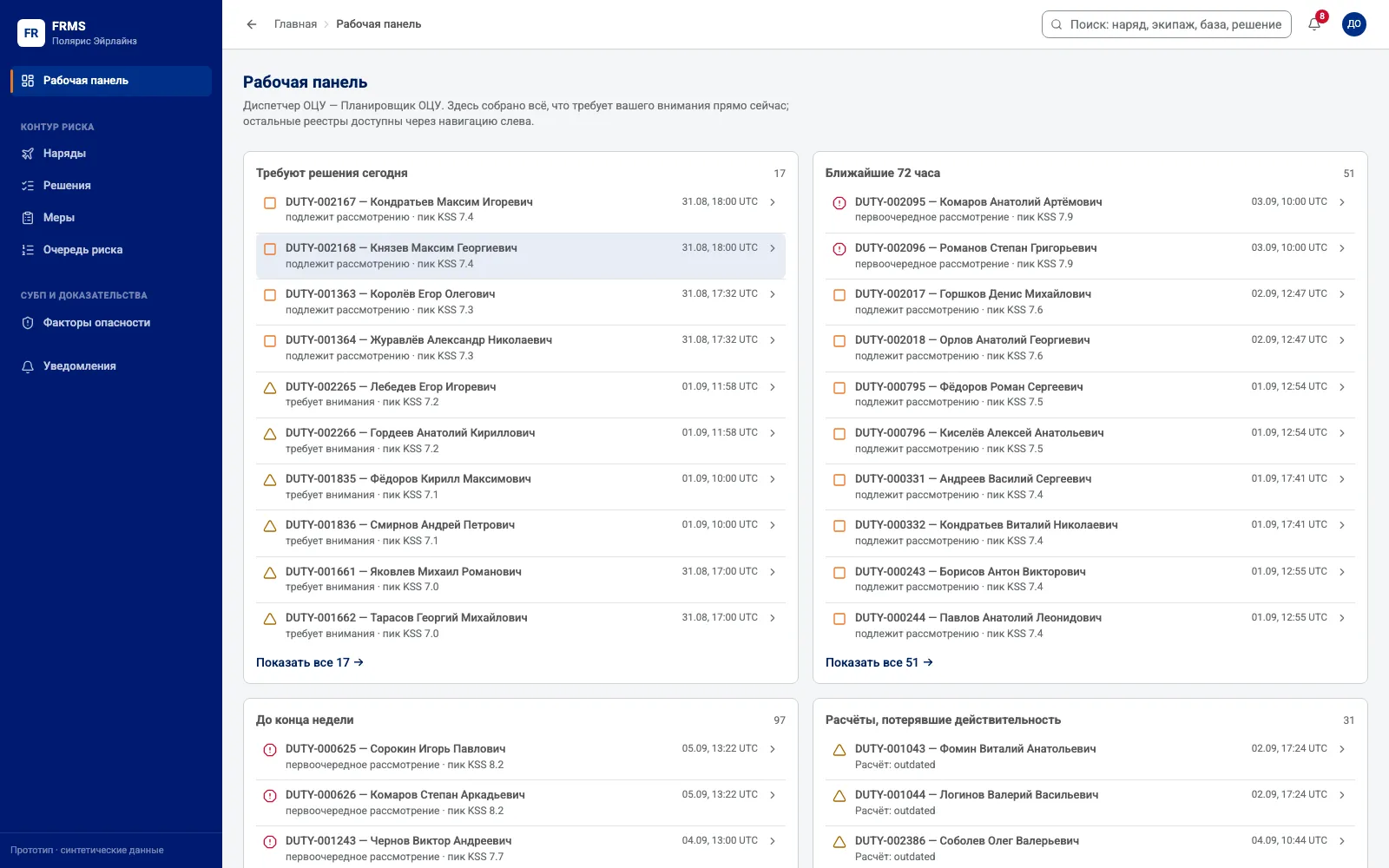
FRMS scores every planned, published and actual duty and returns a sleepiness forecast on the KSS scale, a profile over time and the score broken into its parts.
The planner has the result before the roster is published, can test an alternative in what-if mode and recalculate a duty when a flight is delayed.
Once a decision is taken the system carries the rest of the loop: the measure, its execution, the check on whether it worked, and the hazard factor and indicator handed to the SMS.
The planner, squadron commander, instructor, flight safety office, programme manager and auditor each work with their own slice of data and their own authority. Oversight roles have read access; the separation is enforced by the server.
How it works
The path from source data to a specialist's decision
-
Data sources
Crew duties from the planning system — planned, published, actual, cancelled — and crew fatigue reports.
-
Processing
Every duty passes through a biomathematical engine: sleep and wake profile, sleepiness forecast, the score broken into its parts.
-
Result
The planner sees the score and its grounds before the roster is published and can test an alternative in what-if mode.
-
Specialist's decision
The specialist decides, assigns a measure and follows up on it. Proposing and approving a measure sit with different roles. The hazard factor goes to the SMS.
Key capabilities
- A score for every duty with the sleep and wake profile and an account of what the result is made of.
- What-if mode and recalculation on delay, leaving the source roster untouched.
- Crew fatigue reports; named access belongs to the flight safety office alone and carries its own log.
- Measures with proposal and approval split across roles; no single person moves a threshold.
- A reproducible evidence pack for the auditor, with a checksum and access limited in time.
Interface
Data and integrations
Duties arrive from the planning system under a formal exchange contract: time in UTC, end-to-end identifiers for the duty, the pairing and the crew member, and the states planned, published, actual and cancelled.
Sending the same data twice creates no duplicate records. The result written back to the planning system is held apart from actual operational data.
The calculation runs in a separate biomathematical engine behind a replaceable software interface. The application holds no fatigue model of its own.
Methodology and regulatory basis
The forecast rests on the two-process model of sleep and wakefulness (Daan, Beersma, Borbély, 1984): homeostatic sleep pressure, a circadian component and a sleep-inertia process.
Time constants of 18.2 and 4.2 hours are used; the circadian component is the sum of a 24-hour and a 12-hour harmonic. The result is carried onto the KSS sleepiness scale by the Ingre (2014) regression.
Every constant carries its source, the exact place within that source and a confidence grade. Changing a value calls for a fresh run of the verification suite.
The KSS scale is left unclamped. On extreme rosters the calculation runs past its familiar range; a forced limit would hide exactly the cases that need attention.
Where the system stops
Attention levels on a duty are a presentation rule laid over the engine’s result. They form no second risk model, and the interface shows that boundary plainly.
Likelihood and severity in the SMS risk matrix are set by a person. The model score is never placed into those fields automatically.
The link between fatigue and a given occurrence is likewise established by a specialist. The system does not compute it.
There is no summary score for a pilot. When replacement candidates are compared the order comes from the planning system, and FRMS adds a fatigue forecast for the duty in question.
A time-zone acclimatisation model is not provided by the engine.
What the airline gets
For every duty the calculation, the decision taken, the measure assigned and the result of its check are kept. The history can be reconstructed for an internal review or an audit.
The planner compares options before the roster is published and leans on a number.
Crew fatigue reports sit alongside the calculation for the same duty. The auditor receives a reproducible pack of data in place of a manual selection from correspondence and scattered sources.